Cultivating life
Qigong is an integral part of Chinese medicine, Chinese martial arts and spiritual practice. Historically, much of its development was driven by the search for greater health and longevity.
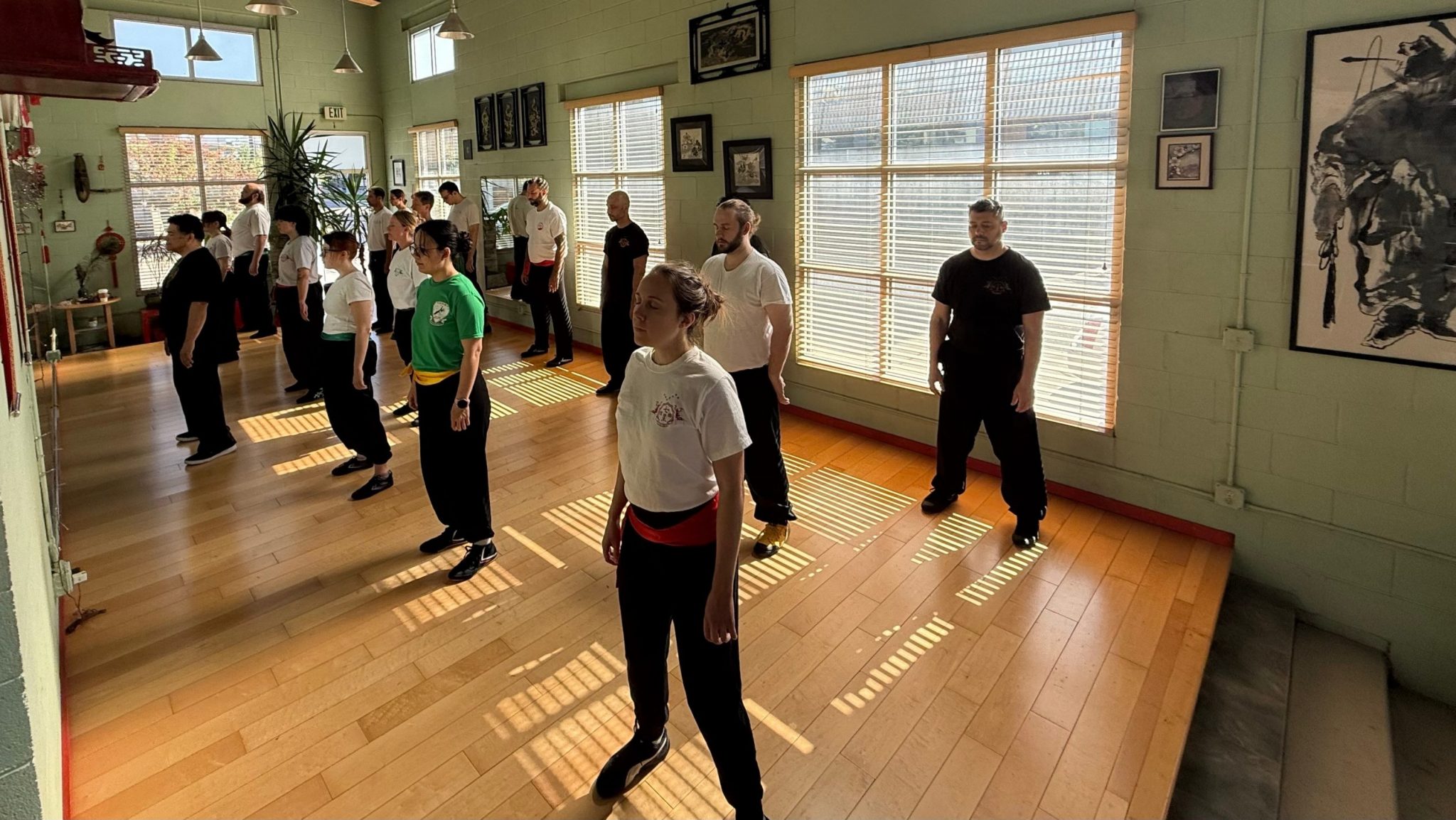
The first type of Qigong taught at Boulder Kung Fu Academy is dynamic. Gentle movements blend with relaxed, intentional breathing and may also include self-massage. Traditionally, this is understood to promote the movement of blood and qi throughout the body for health and healing. Practice can also quiet the mind, ground the body and return our awareness to the present moment.
Two broad approaches
Static and dynamic Qigong
Qigong practices can be broadly divided into two categories.
01
Static Qigong
Static Qigong is generally practiced standing, seated or lying down without intentional movement. The practitioner uses particular methods of breathing, focused attention and visualization to cultivate qi and guide its circulation through the body.
Examples include dantian breathing, the Microcosmic Orbit and Five Gate Breathing.
02
Dynamic Qigong
Dynamic Qigong is practiced through movement sequences, sometimes accompanied by self-massage. The movements and breathing methods vary according to the practice.
Traditionally, dynamic Qigong is understood to support spirit, qi and blood while strengthening the muscles, tendons, ligaments and bones.
Examples include Liangong, the Six Healing Sounds and the Eighteen Lohan (Shiba Luohan).
Health and healing
Strengthening the body from within.
According to traditional Chinese medicine, qi moves through the organs and meridians of the body. When qi circulates freely, the organs and tissues are nourished and the body is better able to maintain balance and resist illness.
Traditional Chinese medicine also recognizes a relationship between physical and emotional health. Sustained stress and emotional distress may disrupt the movement of qi, while these imbalances may also be associated with experiences such as anxiety or depression.
Depending on the method, Qigong may use posture, breathing, focused attention or movement to work with the circulation of qi and support greater balance within the body.
People also practice Qigong to ease pain and stiffness in the neck, shoulders, back and joints; improve flexibility and stability; support energy and vitality; and help prevent injury and fatigue.
Through regular practice, the practitioner develops methods of self-healing for body, mind and spirit.
Qigong and martial training
Part of the Academy’s tradition.
Qigong has been practiced in China for thousands of years and has been an integral part of Chinese martial arts for centuries. It remains part of the Academy’s regular curriculum. The Eighteen Lohan (Shiba Luohan) is a form of martial Qigong transmitted within the Academy’s Seven-Star Praying Mantis tradition.
Current Qigong training
Future classes and focused offerings.
Weekly Qigong group training is currently on pause. Future training may take the form of a class series, workshop or another focused offering.
Private Qigong instruction is available selectively.
Join the Academy newsletter to hear about future Qigong training, workshops and other school offerings.